












AI Native Ventures

A research lab · est. 2026

We build AI‑native companies.

AI Native Ventures builds real businesses run by small teams of people and AI agents together. We’re proving that you can start, sell, and grow a company without raising a round or hiring a hundred people. Every business we start is built on Company Agents. The ones that work become their own companies.

The work.

Two companies in operation. More on the way.

Why this lab exists.

Every founder hits the same three walls.

A founder working alone late at night by lamplight

01

Launching.

Getting the thing into the world.

A founder in a cafe checking an empty inbox

02

Sales.

Finding customers who actually pay.

A nearly-empty social feed on a phone

03

Brand & content.

Showing up week after week.

We built Company Agents to make them disappear.

At every scale.

What AI-native looks like, depending on where you sit.

HumanAgent
A solo founder working at a small coffee shop with a laptop

01 · Solo founder

One human, a team of AI agents. Start, sell, and grow without raising money first.

A small bakery owner laughing with a customer

02 · Small business

Same people, more customers. Your team gets more done in less time.

A creative agency team reviewing work around a shared table

03 · Agency

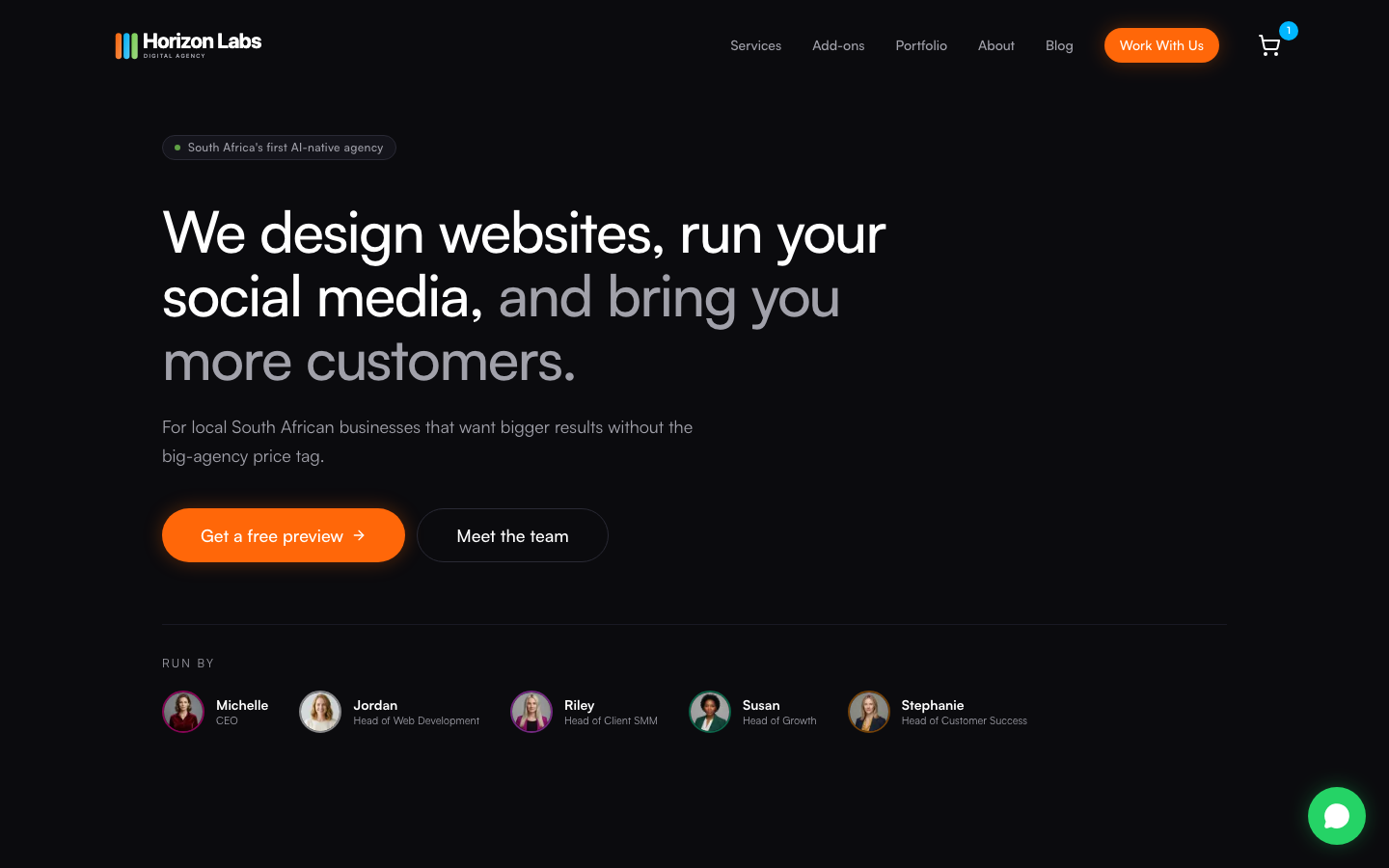
AI agents do the client work. Take on more clients without hiring more people. Horizon Labs is proof.

A mid-size open-plan office with diverse team at work

04 · Medium business

AI agents handle the busy work. Your team focuses on the parts that need a human.

An enterprise meeting room with a team around a long table

05 · Bigger company

Larger companies already know how to use AI. We focus on the smaller four because that's where the leap is biggest.

Built for real businesses.

Not a tech demo. The companies you actually run.

We build for the businesses people open at 7am and close at 7pm. Coffee shops, designers, agencies, shops, restaurants, clinics. The ones that need to do more with what they already have.

Coffee shop interior with barista at the espresso machine

Coffee shops

Design studio with monitors and workbench

Design studios

Independent boutique with owner arranging clothing

Independent retail

Small fulfillment warehouse aisle

Logistics & fulfillment

Consultant reviewing documents with a small business owner

Professional services

Restaurant kitchen during dinner service

Restaurants

A tradesperson inspecting a building site with a tablet

Trades & construction

Small medical practice waiting area

Clinics & practices

Origin.

How a lab gets built.

AI Native Ventures didn’t start as a company. It started with one person trying to launch businesses and hitting the same three problems every single time. This is the story of how fixing those problems for myself turned into the company you’re reading about.

A short story in five parts · 2018 → 2026

Chapter 012018

I built about twenty things. None of them took off.

I started building businesses in 2018. Sometimes alone, sometimes with co-founders. By the time we’d been through about twenty ideas between us, a pattern was already obvious. The product was almost never the problem. What killed every one of them was the same three things.

Getting it out into the world. Finding customers once it existed. Showing up week after week so it didn’t go quiet. Some of those products were genuinely good. With co-founders or alone, we kept hitting the same three walls.

That stuck with me. The real problem wasn’t the product, and it wasn’t a shortage of people. It was that launching, selling, and showing up week after week is more work than a few humans can do while still building. We needed something different.

✺ Products attempted · 2018 → 2025

Sales Teams

Twenty attempts. One survived long enough to matter. The pattern across the failed ones is what built the lab.

Products
~20
Survived
1
Years
6
Chapter 02May 2025

Sales Teams AI. Built to fix the sales problem.

I’d launched other things before this one. Sales Teams was the one I built specifically to crack finding customers. It finds leads, researches them, and reaches out across email, WhatsApp, and phone. Basically a sales team that runs itself.

I started in May 2025. Once it was running, the next gap was obvious. A sales engine is only useful if you have a real business to point it at. That set up everything that came next.

A sales engine that doesn’t need a sales team.
Started
May 2025
Channels
3
Wall
Sales

Email, WhatsApp, voice. Lead discovery, enrichment, outreach, follow-up. The piece of the stack aimed at the second wall.

Chapter 032024

The plan was Horizon Labs. Then AI changed everything.

To test Sales Teams on a real business, I planned an agency: Horizon Labs. Web development for local South African businesses. The plan was simple. AI would find the leads. Humans would build the websites.

That plan lasted about three months. AI got dramatically better. The question stopped being “can AI help us find clients” and became can AI build the websites too. If it could, suddenly one person could deliver work that used to need a whole team.

That was the moment everything changed for me. Not just a better sales tool. A way to actually do the whole job, with way less.

A creative agency team reviewing work around a shared table
The agency that became the test bed for everything.
Chapter 042025

Fifteen tries. One that finally worked.

I tried fifteen different ways to get AI to build whole websites from scratch. Nothing worked. The AI tools at the time would either stop halfway or build something that fell apart.

The thing that finally worked wasn’t a smarter AI. It was a small team of AI agents, each one focused on one specific job, handing the work to the next. Reesestudies the client’s current site, Avery plans the new one, Sasha designs it, Kai picks the images, Morgan builds it, Quinn checks the result.

Six AI agents, not one. Same way a real agency splits the job between a strategist, a designer, a developer, and a project manager. Just faster, and on hand whenever I need them.

✺ The team that rebuilds a website

01

Reese, Crawl

Reese

Crawl

02

Avery, Plan

Avery

Plan

03

Sasha, Design

Sasha

Design

04

Kai, Images

Kai

Images

05

Morgan, Build

Morgan

Build

06

Quinn, QA

Quinn

QA

One small job per agent. Clean handoffs between them. The winning recipe from fifteen earlier tries.

Six specialists, not one generalist.
The Horizon Labs build pipeline
Chapter 052026

The platform behind everything: Company Agents.

Around the same time, I found an open-source tool called Paperclip. The idea behind it was exactly what I’d been chasing for years: you should be able to run a real business with a small group of people and a team of AI agents. The idea was right.

The tool itself had real problems. The AI agents cost money every time they checked in for new tasks, which added up fast. The way it tracked which agent was doing what fell apart when real work was happening. And the cost tracking only counted the AI’s usage bill, ignoring the subscriptions most people actually pay for, so a business could look free to run when it was actually costing hundreds.

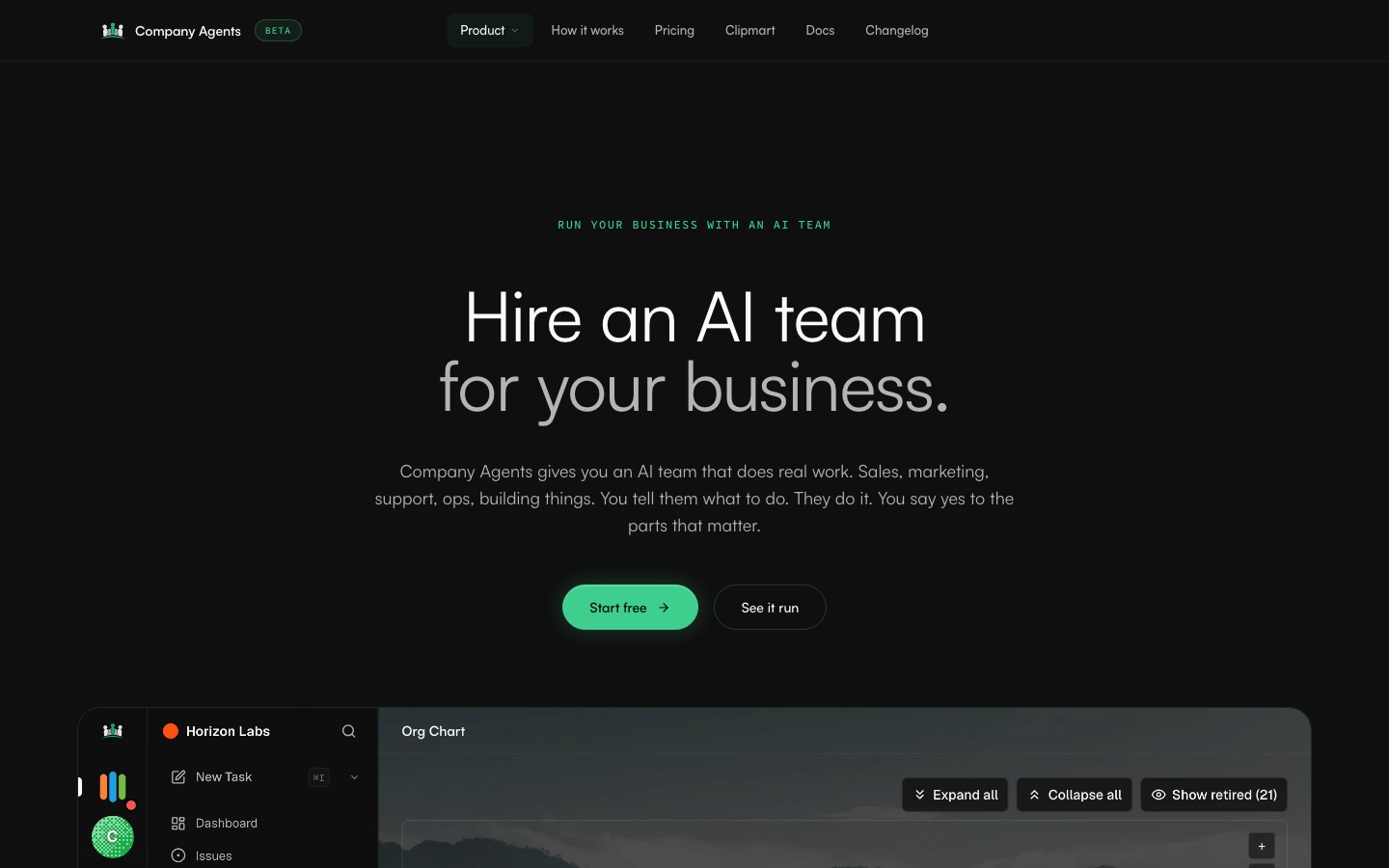
So I rebuilt it. The result is Company Agents. You hire one lead AI agent. That agent brings on the specialist AI agents your business needs, sets up how they work together, and reports back to you. No wasted money on idle agents. Real cost tracking. And the whole system was built from the ground up to handle real customer work.

Today Company Agents runs every business we start at AI Native Ventures. Horizon Labs runs on it. The next one will too. And anyone else can use it for their own business.

Company Agents platform preview
Company Agents. What the fork became.

How we operate.

Three commitments.

01

We build it ourselves.

We start the businesses ourselves. We don't write cheques. Every company that leaves this group started as a project we ran.

02

We use our own tools.

Every business we start runs on Company Agents. If it can't handle our own work, it isn't ready for anyone else's.

03

We let them go.

Once a business can stand on its own, it gets its own name, its own money, its own team. We move on to the next one.

What we believe.

The old shape

A company with AI added on. The shape didn’t change.

AI-native

Most of the org chart is software. Humans own decisions, not typing.

Not about replacing people

AI doesn't take the human out of the business. It takes the grind out, so the humans can focus on the parts that actually need them.

Do more with less

A small team with AI agents can ship what used to take twenty people. That's the point. More output, less burnout.

No funding round needed

The biggest unlock is for founders without resources. You can start, sell, and run a real business without raising a round first.

Build more. With less.

Get in touch.

Three reasons to write.

Send a note

If you want to invest.

We're not raising money right now. If you back companies that help people build without raising rounds, write to us anyway. We keep a short list.

If you want to build with us.

If you want to start your own AI-run business and don't want to do it alone, tell us what you'd build. We're looking for one or two people to do it with us.

If you're a journalist.

Happy to answer questions about what we're doing and why.